Saturday, October 29, 2022

Youth Festival

We were having 30th Youth festival in Maharaja Krishnkumarsinhji Bhavnagar University 


Youth festival starts with Kala Yatra
That is how all colleges were represented in Kala Yatra.


After that there was opening ceremony where Safin Hasan sir (An IPS officer) had given speech as a guest and said that our young generation is confused one,they need a good guidence and support.

Youth Festival Day-1 (19-9-2022) :

On the first day of the youth festival there were so many different competitions and students also participated enthusiastically. First program starts with the opening ceremony which is held at the Amphitheater. Here are some pictures of the opening ceremony.

Here, I shared the list of Competitions of the first Day with the places.

• Mimicry (Atal Auditorium)

Bhajan (Old Court Hall)

⚫ Tatkal Chitr (Live Drawing) (External Department) • Prashna Manch (Quiz) (English Department)

⚫ SvaRachit Kavya Pathan (Poetry Making) (English Department)

⚫ Lok Nritya (Folk Dance) (Amphitheatre)

Mime (Atal Auditorium)

⚫ Halvu Kanthy Sangit (Sugam Geet) (Old Court Hall)

• Collage (External Department).

20-9-2022 : Second day of Youth Festival 

Here is a list of second day competitions


⚫ Samuh Geet (Western) (Amphitheatre)

• Ekanki (Atal Auditorium)

• Shastriya Gayan (Old Court Hall)

• Poster making (External Department)

• Parshana Manch Final (English Department)

⚫ Western Song (solo) (Amphitheatre)

Lok Geet (Old Court Hall)

Clay Modeling (External Department)

Mono Acting (Atal Auditorium)

• Shastriya Vadan (Tal Vadhy) (Old Court Hall)

Mehndi (External Department)

Nibandh (English Department) Shastriya Nritya (Atal Auditorium)

• Tatkal Photography (External Department)

Short Film (English Department)

⚫ Lok Vadhy Vrund (Amphitheatre)

Skit (Atal Auditorium)

⚫ Shastriya Vadan (Svar Vadhy) (Old Court Hall)

⚫ Cartooning (External Department)

Duha Chhand (Amphitheatre)

21/09/2022 : Youth Festival third day 

Here is a list of third day competitions with the places.

Samuh Geet (Bhartiy) (Amphitheatre)

• Vaktratva (Elocution) (Old Court Hall)

• Rangoli (External Department)

• Installation (External Department)

• Debate (New Court Hall).

Students of the English Department also participated in various competitions and also won the prizes:
Essay Writing-Divya Parmar

Rangoli - Jheel Barad

Paper Collage-Bhavna Sosa

Mahendi :Emisha Ravanti

Mono Acting: Dhvani Rajyaguru

Elocution - Dhvani Rajyaguru

Painting-Hina Parmar

Quiz-Nirav Amreliya and Hinaba Sarvaiya and Hirva Pandya 

Installation-Upasna Goswami,

Insiyafatema Alvani,

Drashti Joshi and 

Ghanshyam Kataria

Photography-Divya Sheta,Short Film-Divya Parmar

Divya Sheta

 Poetry Written : Himanshi Parmar 

Nilay Rathod

Debate:Kosha Bhatt and Rajeshwari Rana 

# Youth Festival in my point of view

I have completed my graduation with BRS (Batchelor of Rural Studies) at Lokbharari Lokseva Mahavidyalaya which is working on the base of the Nayi Talim and had prohibited any kind of competition and Internet based work to students they had opened digital studies now But competition is still prohibited and that is the reason I was totally unaware of that kind of competition.
That kind of Festivals can lead students towards success in the field where students are interested and having talent and also others can improve themselves by observation.
Obviously world can be more peaceful without competition but a healthy competition is necessary to improve,discover and explore our talent.


Friday, October 28, 2022

Hard Times

 Hard Times 

 Hard Times is a novel written by Charles Dickens which we are having in our syllabus and Dilip Barad sir had given a task to write one blog on this novel.


                Musical adaptation of the novel 'Hard Times' 

There is one musical play adaptation of the novel written by Charles Dickens where there is a one line of the song is

"Emotion, imagination ya compassion se pet kisi ka bharta hai kya ?" 

In my opinion that one should be the point of our concern, specially when we are in the field of education and literature.

Characters of the novel :


Each and every character of the novel is representing their education and it's impact on their lives.

With the reference of his own novel Dickens is telling us that where there is the mistake while we are applying such kind of education in children's mind and life.

Here in the novel we are having Mr.Gradgrind as a a person who is applying his point of view about education in his school which leads every student's life in disaster even his children too have suffered because of his wrong perception of education.
There is one well known person named Nanabhai Bhatt, who had applied education of 'Nai Talim' with developing schools and colleges.

 
Education which is applying 'Nai Talim' have merged Hand,Heart and Mind which helps students to develop their own concept of life because education is not for the only sake of information and technology it should teach students that 'Hand which is feeding can slap also(In the novel Mr.Gradgrind is calling 'Hands' to his works and labourers because they are working for him and feeding him)


This image is also showing us that education have to merge literacy, technology,,and skills to use Sickle, computer,Pen and broom together.


I would like to add one more thing in this idea of Einstein that with the training of mind to think and ability about imagination is not enough only a person or a student should learn about how to use our thought of mind in a productive way.

Thank you for visiting and reading my analysis about that novel and the concept which Dickens is trying to make clear infront of our contemporary educatinalists, teachers and learners.
If you are having any suggestions then I am waiting for the precious idea which can help me and others to improve 😊


Friday, October 14, 2022

Visit of Victoria Park - Bhavnagar

We visited Victoria Park as a part of Romanticism,which we are having in our syllabus.
Nature was a leading figure of romantic poetry, which can make everyone stress free and that is the magic of nature .


We sang songs,had a lunch together.As it is the season of rain,we enjoyed a lot.

I do remind the song by Dhruv bhatt,

" કદી તું ઘર ત્યજી ને રે....
વગડે લીલા ઘાસ, ઉડેલી ધૂળમાં તારી જાત ને ખો ને રે "

Medicine can heal the body but there is something which can heal the soul.

Nature can lead a person towards peace and all the creations will come with that peace of mind.


Thank you for visiting... save the nature that it may have a chance to nurture.


Pride and Prejudice

We are having that novel in our syllabus and Yesha ma'am had given this task to us that we have to write one blog on this novel.

Jane Austen : Jane Austen is an English writer of Romantic age and she has written six novels. The common theme of her novels is Love, Relationship, Marriage, analysis of social life and family matters.


Six novels by Jane Austen :

 1.Sense and Sensibility (1811),
 2.Pride and Prejudice (1813),
 3.Mansfield Park (1814), 
4.Emma (1815), 
5.Persuasion and 
6.Northanger Abbey (both 1817).

Pride and Prejudice :  I am not going to discuss the summary of the novel or the story telling,but some of the dialogues which should be noticed.

The first dialogue of the novel is the dialogue with which Austen is trying to show the harsh reality of our society where that kind of things are still happening.

"It is a truth universally acknowledged, that a single man in possession of a good fortune, must be in want of a wife".

It doesn't mean everyone should marry to invite more troubles when everything is going well.

My favorite scene of the movie : I do like beginning scene more than any other scenes of the movie because it is having a beautiful world of Elizabeth 
An awesome morning vibes...when in the whole movie is all about the Pride and Prejudice of human nature which is true indeed. 

Characters of the novel :

Elizabeth Bennet

The novel's protagonist. The second daughter of Mr. Bennet, Elizabeth is the most intelligent and sensible of the five Bennet sisters. She is well read and quick-witted, with a tongue that occasionally proves too sharp for her own good. Her realization of Darcy's essential goodness eventually triumphs over her initial prejudice against him.
Her sharp tongue and tendency to make hasty judgments often lead her astray; Pride and Prejudice is essentially the story of how she (and her true love, Darcy) overcome all obstacles-including their own personal failings-to find romantic happiness. Elizabeth must not only cope with a hopeless mother, a distant father, two badly behaved younger siblings, and several snobbish, antagonizing females, she must also overcome her own mistaken impressions of Darcy, which initially lead her to reject his proposals of marriage. Her charms are sufficient to keep him interested, fortunately, while she navigates familial and social turmoil. As she gradually comes to recognize the nobility of Darcy's character, she realizes the error of her initial prejudice against him.

Fitzwilliam Darcy

A wealthy gentleman, the master of Pemberley, and the nephew of Lady Catherine de Bourgh. Though Darcy is intelligent and honest, his excess of pride causes him to look down on his social inferiors. Over the course of the novel, he tempers his class-consciousness and learns to admire and love Elizabeth for her strong character.

Jane Bennet

The eldest and most beautiful Bennet sister. Jane is more reserved and gentler than Elizabeth. The easy pleasantness with which she and Bingley interact contrasts starkly with the mutual distaste that marks the encounters between Elizabeth and Darcy.

Charles Bingley

Darcy's considerably wealthy best friend. Bingley's purchase of Netherfield, an estate near the Bennets, serves as the impetus for the novel. He is a genial, well-intentioned gentleman, whose easygoing nature contrasts with Darcy's initially discourteous demeanor. He is blissfully uncaring about class differences.

How did Jane and Bringley make the novel significant ?

As I have written above about the personalities of Jane Bennet and Charles Bingley that they are having a simple mind without any differences, during the whole novel Jane didn't show her eagerness to marry a wealthy and upper class person and Bringley didn't Denied to marry a lower class girl or never showed his pride about his class and money.

Despite their centrality to the narrative, Jane and Bingley are vague characters, sketched by Austen rather than carefully drawn. Indeed, they are so similar in nature and behavior that they can be described together: both are cheerful, friendly, and good-natured, always ready to think the best of others; they lack entirely the prickly egotism of Elizabeth and Darcy. Jane's gentle spirit serves as a foil for her sister's fiery, contentious nature, while Bingley's eager friendliness contrasts with Darcy's stiff pride. Their principal characteristics are goodwill and compatibility, and the contrast of their romance with that of Darcy and Elizabeth is remarkable. Jane and Bingley exhibit to the reader true love unhampered by either pride or prejudice, though in their simple goodness, they also demonstrate that such a love is mildly dull.

Mr.Bennet 
Mr. Bennet is the patriarch of the Bennet household-the husband of Mrs. Bennet and the father of Jane, Elizabeth, Lydia, Kitty, and Mary. He is a man driven to exasperation by his ridiculous wife and difficult daughters. He reacts by withdrawing from his family and assuming a detached attitude punctuated by bursts of sarcastic humor. He is closest to Elizabeth because they are the two most intelligent Bennets.

Initially, his dry wit and self-possession in the face of his wife's hysteria make Mr. Bennet a sympathetic figure, but, though he remains likable throughout, the reader gradually loses respect for him as it becomes clear that the price of his detachment is considerable. He is in fact a weak father who, at critical moments, fails his family. In particular, his foolish indulgence of Lydia's immature behavior nearly leads to general disgrace when she elopes with Wickham. Further, upon her disappearance, he proves largely ineffective. It is left to Mr. Gardiner and Darcy to track Lydia down and rectify the situation. Ultimately, Mr. Bennet would rather withdraw from the world than cope with it.

Mrs.Bennet 
Mrs. Bennet is a miraculously tiresome character. Noisy and foolish, she is a woman consumed by the desire to see her daughters married and seems to care for nothing else in the world. Ironically, her single-minded pursuit of this goal tends to backfire, as her lack of social graces alienates the very people (Darcy and Bingley) whom she tries desperately to attract. Austen uses her continually to highlight the necessity of marriage for young women.
 Mrs. Bennet also serves as a middle-class counterpoint to such upper-class snobs as Lady Catherine and Miss Bingley, demonstrating that foolishness can be found at every level of society. In the end, however, Mrs. Bennet proves such an unattractive figure, lacking redeeming characteristics of any kind, that some readers have accused Austen of unfairness in portraying her-as if Austen, like Mr. Bennet took perverse pleasure in poking fun at a woman already scorned as a result of her ill-breeding.
Lydia Bennett 
Lydia is the youngest and wildest Bennet daughter. She is her mother's favorite because like Mrs. Bennet, she is preoccupied with gossip, socializing, and men. Lydia is described as having "high animal spirits and a sort of natural self-consequence." She is attractive and charismatic, but she is also reckless and impulsive. Lydia's behavior frequently embarrasses her older sisters, and when Lydia receives the invitation to go to Brighton.
Elizabeth makes an impassioned speech about her sister's character,She explains that "our respectability in the world must be affected by the wild volatility, the assurance and disdain of all restraint which mark Lydia's character" Elizabeth also articulates her fear that Lydia is on the road to becoming "a flirt in the worst and meanest degree of flirtation." Lydia has an innate tendency toward wild and selfish behavior, but as a character she also sheds light on the failings of her parents, and father in particular. Because of her young age and lack of education, Lydia is presented as not entirely culpable for her behavior because she lacks parental guidance and discipline.

We can notice here,each character of the novel is getting psychological development in their mentality and actions but Lydia Bennett is remaining the same, Foolish and Wild.

Charlotte Lucas

Charlotte is initially described as "a sensible, intelligent woman... who was Elizabeth's intimate friend." Because of this intelligence, Elizabeth assumes that Charlotte shares her values, even though Charlotte is actually much more pragmatic and even cynical. For example, after Charlotte makes a series of speeches explaining that "Happiness in marriage is entirely a matter of chance" and highlighting the importance of choosing a partner who can provide economic stability, Elizabeth gently rebukes her, explaining that "You know it is not sound and you would never behave in this way yourself." Because Elizabeth is blind to Charlotte's true values, she feels shocked and betrayed when Charlotte chooses to marry Mr. Collins. Charlotte's character is consistent throughout; when Elizabeth goes to visit her after her marriage, she is forced to "meditate upon Charlotte's degree of contentment... and to acknowledge that it was all done very well." Charlotte accurately assesses her priorities and what she needs to be happy, and chooses accordingly. As a result, she stands in contrast to Elizabeth, who forms inaccurate assessments of situations and people.


I do like the novel in a version of book where I can read by my own way ofcourse I would like to refer the movie to make a difference between my thinking and the another way of analysis which point I had missed out while reading.


Sunday, September 25, 2022

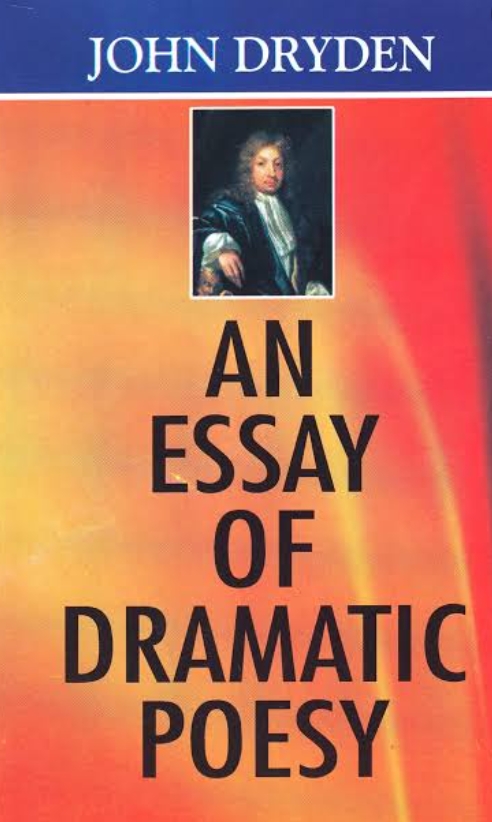
An Essay on dramatic poesy 

Essay of Dramatic Poesie is a work by John Dryden, England's first Poet Laureate, in which Dryden attempts to justify drama as a legitimate form of "poetry" comparable to the epic, as well as defend English drama against that of the ancients and the French. 


It has written during the plague year of 1666, and first published in 1668. In presenting his argument, Dryden takes up the subject that Philip Sidney had set forth in his Defence of Poesie in 1580.


The treatise is a dialogue among four speakers: Eugenius, Crites, Lisideius, and Neander. The four speakers are Sir Robert Howard [Crites], Charles Sackville (then Lord Buckhurst) [Eugenius], Sir Charles Sedley [Lisedeius], and Dryden himself (neander means "new man" and implies that Dryden, as a respected member of the gentry class, is entitled to join in this dialogue on an equal footing with the three older men who are his social superiors).


On the day that the English fleet encounters the Dutch at sea near the mouth of the Thames, the four friends take a barge downriver towards the noise from the battle. Rightly concluding, as the noise subsides, that the English have triumphed, they order the bargeman to row them back upriver as they begin a dialogue on the advances made by modern civilization. They agree to measure progress by comparing ancient arts with modern, focusing specifically on the art of drama (or "dramatic poesy").


The four men debate a series of three topics: 

(1) the relative merit of classical drama (upheld by Crites) vs. modern drama (championed by Eugenius);

 (2) whether French drama, as Lisideius maintains, is better than English drama (supported by Neander, who famously calls Shakespeare "the greatest soul, ancient or modern");

 and (3) whether plays in rhyme are an improvement upon blank verse drama—a proposition that Neander, despite having defended the Elizabethans, now advances against the sceptical Crites (who also switches from his original position and defends the blank verse tradition of Elizabethan drama). 

Invoking the so-called unities from Aristotle's Poetics (as interpreted by Italian and refined by French scholars over the last century), the four speakers discuss what makes a play "a just and lively imitation" of human nature in action. This definition of a play, supplied by Lisideius/Sedley (whose rhymed plays had dazzled the court and were a model for the new drama), gives the debaters a versatile and richly ambiguous touchstone. To Crites' argument that the plots of classical drama are more "just," Eugenius can retort that modern plots are more "lively" thanks to their variety. Lisideius shows that the French plots carefully preserve Aristotle's unities of action, place, and time; Neander replies that English dramatists such as Ben Jonson also kept the unities when they wanted to, but that they preferred to develop character and motive. Even Neander's final argument with Crites over whether rhyme is suitable in drama depends on Aristotle's Poetics: Neander says that Aristotle demands a verbally artful ("lively") imitation of nature, while Crites thinks that dramatic imitation ceases to be "just" when it departs from ordinary speech—i.e. prose or blank verse.


A year later, the two brothers-in-law quarrelled publicly over this third topic. In Dryden's "Defence of An Essay of Dramatic Poesy" (1669),where Dryden tries to persuade the rather literal-minded Howard that audiences expect a play to be an imitation of nature, not a surrogate for nature itself.

Wordsworth's preface to lyrical ballads


Bridge Course:- 
Wordsworth's Preface


William Wordsworth born on 7th April 1770, Cockermouth, Cumberland, England and died on 23rd April 1850, Rydal Mount, Westmoreland. He was the second of five children born to John Wordsworth and Ann Cookson. Wordsworth's father was a legal representative of James Lowther, 1st Earl of Lonsdale. He is one of the pioneers in beginning the romantic moment with Samuel Tyler Coleridge (1772-1834). Wordsworth was Poet Laureate from 1843 until his death from pleurisy on 23 April 1850. The Monarch of that time was Queen Victoria. He was Preceded by Robert Southey and Succeeded by Alfred, Lord Tennyson. Mary Hutchinson was considered as his wife. He has one girl child named Dorothy "Dora" Wordsworth. 

His major works are as following :- 

Lyrical Ballads (1798)
The Prelude(1850)
The Excursion (1814)
Michael (1800)
The Lucy Poem (1798)
Ode on the intimations of immortality from recollections of early childhood(1807)
Sonnets by William Wordsworth (1838)
Here is a video on William Wordsworth, maybe it helps you to understand him more clearly.


1 - WHAT IS POETRY?

"Poetry is the spontaneous overflow of powerful feelings: it takes its origin from emotion recollected in tranquility."
- William Wordsworth 

That means one cannot plan a poem, it comes naturally with overflowing powerful feelings. According to Wordsworth, there are four stages in the creation of poetry of a true poet:-

Observation
Recollection
Contemplation
Creation

The poetry which has all this stages perfectly it gives immense joy to the poet and he shares it with his readers. Blake, he also reject aristotelian doctrines of poetry by saying that plot, or situation, is not the first thing but it is this strong feeling that matters.

WORDSWORTH'S POETIC THEORY :-
Wordsworth was profoundly influenced by the French Revolution it's slogan 'Liberty, equality, and fraternity.' The three magic terms were one of the triggers for Wordsworth to break away from the rule bound poetry of the previous Neo-classical age into a whole new poetic theory of 'inner evidence of sensation and spontaneous feeling.'
Found the need of writing the preface in the second edition of Lyrical Ballads to respond to the question raised to his advent of a new type of poetry. which is preface he has put for his point of you and remove the bitter criticism of his poems. Secondly, he made readers aware about the different type of poetry he had composed to make them understand his poetry. Lastly, he wanted to re-establish Shakespeare in Milton over 'frantic novels, sickly and stupid German tragedies, and flood of idle and extravagant stories in verse'. 


2 - WHY DOES WORDSWORTH SAY 'WHAT' IS POET? RATHER THAN WHO IS POET?

Wordsworth gives a voluminous explanation on the meaning of the word 'poet' and 'what is poet?' rather than 'who is poet?' he says a poet is a man speaking to man, affluent with more lively sensibility, more enthusiasm and delicacy, who has a greater knowledge of human nature, who knows how other man are feeling, who knows how my writing affect them, and a more capacious soul. Who deeply knows and who rejoices, more than other men in the spirit of life, habitually urged to create volition, passion and situations where he does not find them. 
William Wordsworth speak about it in preface of Lyrical Ballads that,

"He is a man speaking to men: a man, it is true, endued with more lively sensibility, more enthusiasm and tenderness, who has a greater knowledge of human nature, and a more comprehensive soul, than are supposed to be common among mankind; a man pleased with his own passions and volitions, and who rejoices more than other men in the spirit of life that is in him; delighting to contemplate similar volitions and passions as manifested in the goings-on of the universe, and habitually impelled to create them where he does not find them."

R.A. Scott-James calls it 'The Summum Bonum of the poet's life'. 
Through this lines Wordsworth gave his point of view that poet should be one who know to write on that Something comes from the heart. The general people don't have that sense and inner understanding. A poet is more happy and delightful than the ordinary person. And he should know to make how to make volition where he does not find it. He should please with his own passion. And most importantly he should have the great knowledge of human nature and personality that how my writing affect everyone. 
Here is a video on this topic coverd by Professor Dilip Barad and Dr. Sanjay. 


3 - WHAT IS POETIC DICTION? WHICH SORT OF POETIC DICTION IS SUGGESTED BY WORDSWORTH IN HIS PREFACE? 

In his works Preface to Lyrical Ballads an essay, he addresses his point of view and meaning of poetic diction. 
If we look at the dictionary meaning of poetic diction it simply means 'choice of words' which used as a style by or in the particular poet and poem. Here Wordsworth, poetic diction means, 'a selection of language really used by men' specially man of 'humble and rustic life' to make the poetry more interesting, popular among common readers and to give poetic pleasure to all. He avoids poetic diction of the previous age, he doesn't support the idea of using artificial metaphors and other figure of speech or any other device to decorate the poem or to make the style higher. 
Wordsworth also described that there is no difference between language of prose and poetry. The arrangement or order of words used in the best poetry can also be found in the prose. Only the use of metre can differentiate the difference between the poetry and prose. According to him, readers can easily follow the rules of metre. It does not make any interference with the passion of readers. 

4 - I WANDERED LONELY AS A CLOUD


I wandered lonely as a cloud
That floats on high o’er vales and hills,
When all at once I saw a crowd,
A host, of golden daffodils;
Beside the lake, beneath the trees,
Fluttering and dancing in the breeze.

Continuous as the stars that shine
And twinkle on the Milky Way,
They stretched in never-ending line
Along the margin of a bay:
Ten thousand saw I at a glance,
Tossing their heads in sprightly dance.

The waves beside them danced, but they
Out-did the sparkling waves in glee:
A poet could not but be gay,
In such a jocund company:
I gazed—and gazed—but little thought
What wealth the show to me had brought:

For oft, when on my couch I lie
In vacant or in pensive mood,
They flash upon that inward eye
Which is the bliss of solitude;
And then my heart with pleasure fills,
And dances with the daffodils.

The poem I wondered lonely as a cloud also know as Daffodils. The poem does describe the beauty and power of the flowers. Daffodils ultimately turns out to be a beautiful, dramatic lyric on the poets spiritual conversation in the company of nature. Daffodils based on a real life experience of the poet and his sister Dorothy helps him to write it. This poem was composed in 1807.
The poet narrates his experience when he used to wander as a cloud on the highest pick of hills and vales. During his wandering he happened to see a lot of yellow flowers which tall stems and long narrow leaves. They were Daffodils. There were spread around lake, beneath the trees. When he saw the Daffodils he feels like Daffodils are dancing with the breeze. It also shows that daffodils enriches the beauty of nature. Than Wordsworth compared daffodils with shining star. In a milky way there are thousands of stars like that there were large number of Daffodils. The Daffodils were becoming more and more beautiful and shining brightly with flashes of light. 
In last the poet says his personal experience. When he is alone lying in his sofa and having serious mood, suddenly he thinks of his past experience of looking Daffodils. This experience gives him a lot of pressure, bliss and happiness. He immediately forgets that he is alone and having serious mood. And that's how he tells us that only nature has that capacity to convert human being from unhappiness to highest bliss. 
Through this poem and brief introduction of the poem that what in this poem and how it came to existence clearly shows the poetic creed of Wordsworth. His belief that poetry must be with full of emotions and spontaneity. He described his highest emotions in this poem. 

Saturday, September 24, 2022

Post truth era

Post-truth is a term that refers to the 21st century widespread documentation of and concern about disputes over public truth claims. The term's academic development refers to the theories and research that explain the historically specific causes and the effects of the phenomenon.

While the term was used academically and publicly before 2016 (post-truth politics).

The news which newspapers and  social media all are spreading can be wrong they are spreading it for their use and foolish people continues to spread it forward without any concern.
 
Some people will tell that nothing is true in the world but truth Exists only falsehood has to be invented.

 For that context we do need to think by our own proper way rather than any other person or fake resources.It may happen that the person himself was unaware about the lie he has spoken It is good to check the information which is correct.